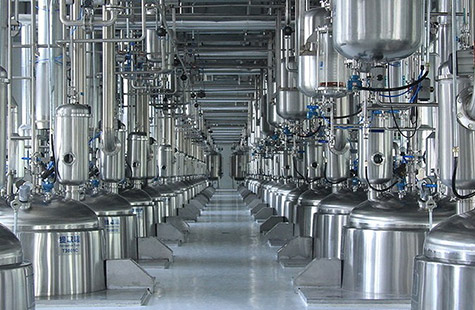
304, 304L, 316, and 316L are four widely used stainless steel grades in sanitary piping, food processing, pharmaceutical equipment, chemical processing, and other industrial applications.
Although these grades have similar appearances, they differ in chemical composition, carbon content, corrosion resistance, mechanical properties, welding performance, applications, and cost.
Understanding these differences can help users select the appropriate stainless steel material for sanitary fittings, valves, tubes, tanks, and other processing equipment.
1. Chemical Composition
The main differences between these stainless steel grades are their carbon content and alloying elements.
| Stainless Steel | Carbon | Chromium | Nickel | Molybdenum |
|---|---|---|---|---|
| 304 | ≤0.08% | Typically 18% | Typically 8–10.5% | — |
| 304L | ≤0.03% | Typically 18% | Typically 8–12% | — |
| 316 | ≤0.08% | Typically 16–18% | Typically 10–14% | 2–3% |
| 316L | ≤0.03% | Typically 16–18% | Typically 10–14% | 2–3% |
The exact chemical composition depends on the applicable material standard, such as ASTM, EN, or other specifications.
The most important differences can be summarized as follows:
- 304 vs. 304L: The main difference is carbon content.
- 316 vs. 316L: The main difference is also carbon content.
- 304 vs. 316: 316 contains molybdenum, which generally provides better resistance to chloride-related corrosion.
- 304L vs. 316L: 316L combines low carbon content with molybdenum-containing alloy chemistry.
2. What Does the “L” Mean?
The “L” stands for “Low Carbon.”
For example:
- 304 → standard carbon version
- 304L → low-carbon version
- 316 → standard carbon version
- 316L → low-carbon version
304L and 316L generally contain no more than 0.03% carbon, compared with up to approximately 0.08% for their corresponding standard grades.
The lower carbon content reduces the tendency for chromium carbide precipitation during welding.
This makes 304L and 316L particularly useful for welded components and fabricated sanitary equipment where resistance to intergranular corrosion is important.
3. Mechanical Properties
Typical minimum mechanical requirements vary according to the applicable material standard and product form.
As a general comparison:
| Material | Tensile Strength | Yield Strength | Main Characteristic |
|---|---|---|---|
| 304 | About 515 MPa or higher | About 205 MPa or higher | Good strength and formability |
| 304L | About 485 MPa or higher | About 170 MPa or higher | Low carbon, good weldability |
| 316 | About 515 MPa or higher | About 205 MPa or higher | Good strength and corrosion resistance |
| 316L | About 485 MPa or higher | About 170 MPa or higher | Low carbon, good weldability |
These values are representative of common ASTM requirements for certain product forms and should not be treated as universal values for every specification.
Actual mechanical properties depend on:
- Material standard
- Product form
- Heat treatment
- Manufacturing process
- Thickness
- Cold working
4. Corrosion Resistance
Corrosion resistance is one of the most important differences between 304 and 316 stainless steel.
4.1 304 Stainless Steel
304 stainless steel provides good general corrosion resistance and is widely used in:
- Food processing
- Beverage equipment
- Sanitary piping
- Chemical equipment
- Architectural applications
- General industrial equipment
It is suitable for many water-based and relatively mild processing environments.
4.2 304L Stainless Steel
304L has corrosion resistance broadly similar to 304 in many environments.
Its major advantage is its low carbon content, which makes it more suitable for welded structures where resistance to weld-related intergranular corrosion is important.
It is commonly used for:
- Welded sanitary piping
- Tanks
- Heat exchangers
- Food processing equipment
- Chemical processing equipment
4.3 316 Stainless Steel
316 stainless steel contains molybdenum, which generally provides improved resistance to chloride-induced corrosion compared with 304.
It can therefore be considered for applications involving more aggressive environments.
Common applications include:
- Food processing
- Pharmaceutical equipment
- Chemical processing
- Marine environments
- Medical equipment
- High-purity processing systems
However, 316 is not immune to corrosion. The actual corrosion resistance depends on chloride concentration, temperature, exposure time, surface condition, and other environmental factors.
4.4 316L Stainless Steel
316L combines the corrosion resistance advantages associated with 316 with a low carbon content.
It is particularly suitable for welded sanitary equipment and systems where both corrosion resistance and weld-related corrosion resistance are important.
Typical applications include:
- Pharmaceutical equipment
- Food processing equipment
- Biotechnology equipment
- Chemical processing systems
- Sanitary piping
- Marine and chloride-containing environments
5. 304 vs. 316: What Is the Main Difference?
The most important difference between 304 and 316 is the addition of molybdenum in 316 stainless steel.
In simplified terms:
304 → General-purpose corrosion resistance
316 → Enhanced resistance to chloride-related corrosion
For example, if the application involves higher chloride exposure, salt-containing environments, or more aggressive processing conditions, 316 or 316L may be considered.
However, material selection should always be based on the actual operating environment rather than simply choosing 316 because it is “stronger.”
6. 304 vs. 304L
304 and 304L have very similar corrosion resistance in many normal environments.
The main difference is carbon content.
304
- Higher allowable carbon content
- Good mechanical properties
- Good corrosion resistance
- Widely available
- Suitable for general applications
304L
- Lower carbon content
- Better suited to welded fabrication
- Reduced risk of weld-related intergranular corrosion
- Commonly used in fabricated sanitary equipment
For welded sanitary piping and equipment, 304L is often considered when low-carbon material is beneficial.
7. 316 vs. 316L
The difference between 316 and 316L is also mainly related to carbon content.
316
Provides good corrosion resistance and mechanical properties.
316L
Provides similar alloying characteristics with lower carbon content.
316L is particularly useful for welded structures where resistance to weld-related intergranular corrosion is important.
This is one reason why 316L is widely used for sanitary and pharmaceutical processing equipment.
8. Typical Applications
| Material | Typical Applications |
|---|---|
| 304 | Food equipment, sanitary fittings, piping, general industrial equipment |
| 304L | Welded piping, tanks, food processing equipment, fabricated equipment |
| 316 | Chemical equipment, food processing, marine environments, corrosion-resistant equipment |
| 316L | Pharmaceutical equipment, sanitary piping, biotechnology, chemical equipment, marine applications |
For sanitary products such as sanitary fittings, sanitary valves, sanitary tubes, clamps, and tank components, both 304/304L and 316/316L can be used depending on the application.
9. Price Difference
In general, the price relationship is often approximately:
304 < 304L < 316 < 316L
However, this is not a fixed rule.
Actual prices depend on:
- Nickel price
- Molybdenum price
- Market conditions
- Product size
- Surface finish
- Manufacturing process
- Certification requirements
- Order quantity
316 and 316L are generally more expensive than 304 and 304L because they contain molybdenum and generally provide improved corrosion resistance in certain environments.
10. How to Choose Between 304, 304L, 316 and 316L?
A simple selection guide is:
Choose 304 when:
- The environment is relatively mild.
- General corrosion resistance is sufficient.
- Cost is an important consideration.
- The application involves general food or beverage equipment.
Choose 304L when:
- The component requires extensive welding.
- Low-carbon stainless steel is preferred.
- Weld-related corrosion resistance is important.
Choose 316 when:
- Better resistance to chloride-containing environments is required.
- The operating environment is more aggressive.
- Higher corrosion resistance is needed.
Choose 316L when:
- The equipment requires welding.
- Chloride resistance is important.
- The application has high hygiene or corrosion-resistance requirements.
- Pharmaceutical, biotechnology, chemical, or high-purity processing is involved.
Conclusion
The main differences between 304, 304L, 316, and 316L stainless steel are related to carbon content, alloy composition, corrosion resistance, welding performance, mechanical properties, application requirements, and cost.
The easiest way to remember the differences is:
304 → General-purpose stainless steel
304L → Low-carbon 304 for welded applications
316 → Molybdenum-containing stainless steel with improved chloride resistance
316L → Low-carbon 316, particularly suitable for welded and hygienic applications
For sanitary piping products, the correct material should be selected according to the process medium, temperature, pressure, chloride exposure, cleaning chemicals, welding requirements, surface finish, and applicable industry standards.
