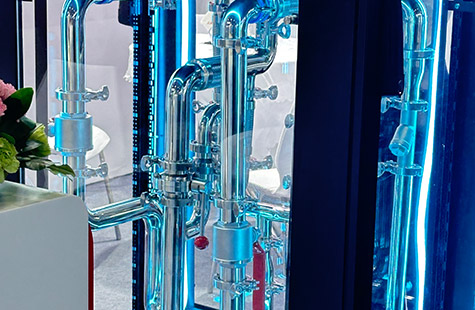
Data center liquid cooling piping is a specialized piping system used to circulate coolant within data center cooling systems. It transports coolant to heat-generating equipment, absorbs heat, and transfers it to heat exchangers, radiators, or other heat rejection equipment.
As data center power density continues to increase, liquid cooling piping has become an important component of thermal management systems for high-performance computing, AI servers, GPU clusters, and other high-density computing applications.
1. Components of a Data Center Liquid Cooling System
A typical data center liquid cooling system consists of several major components, including:
- Coolant
- Liquid cooling pipes
- Pumps
- Heat exchangers
- Radiators
- Fittings and connectors
- Valves
- Coolant reservoirs
- Distribution manifolds
The piping system is the primary flow path for the coolant. It transports coolant from the cooling source to the equipment and carries heated coolant back to the cooling system.
The exact configuration depends on the cooling architecture, equipment requirements, and data center layout.
2. Types of Data Center Liquid Cooling Pipes
Data center liquid cooling piping can generally be divided into two main categories: flexible hoses and metal pipes.
2.1 Flexible Liquid Cooling Hoses
EPDM Liquid Cooling Hose
EPDM (ethylene propylene diene monomer) hoses are widely used in various fluid handling applications because of their flexibility, temperature resistance, and resistance to many chemicals.
Key characteristics include:
- Good flexibility
- Good sealing performance
- Temperature resistance
- Chemical resistance
- Good elasticity
- Easy installation
- Convenient maintenance
EPDM hoses can be considered for liquid cooling applications where flexible connections are required.
However, coolant compatibility should always be confirmed according to the actual coolant composition and hose manufacturer’s specifications.
FEP Corrugated Tubing
FEP (fluorinated ethylene propylene) corrugated tubing provides excellent chemical resistance, temperature resistance, and flexibility.
It can be suitable for applications requiring flexible routing and good resistance to aggressive fluids.
Transparent or translucent FEP tubing can also provide visual access to the fluid inside the tube, making it easier to observe bubbles or visible contamination where the product design allows.
The actual temperature, pressure, and transparency specifications depend on the specific tubing construction.
PTFE Liquid Cooling Tubing
PTFE (polytetrafluoroethylene) is known for its excellent chemical resistance, low friction characteristics, electrical insulation properties, and resistance to aging.
PTFE tubing can be used in demanding liquid cooling applications where high chemical compatibility is required.
Depending on the specific product design, PTFE tubing can operate across a wide temperature range. The actual allowable operating temperature and pressure should always be confirmed with the manufacturer’s technical specifications.
3. Metal Liquid Cooling Pipes
Stainless Steel Corrugated Pipes
Stainless steel corrugated pipes are another option for data center liquid cooling systems.
They are commonly manufactured from 304 or 316L stainless steel, depending on the application requirements.
The corrugated structure provides flexibility and can help accommodate:
- Thermal expansion and contraction
- Mechanical vibration
- Equipment movement
- Installation tolerances
This flexibility can help reduce mechanical stress on connected equipment and fittings.
Stainless steel also provides good corrosion resistance and can be compatible with many commonly used cooling fluids.
However, it is important to verify compatibility with the specific coolant, concentration, temperature, pressure, and sealing materials used in the system.
4. Functions of Data Center Liquid Cooling Piping
Liquid cooling piping plays an important role in data center thermal management.
4.1 Efficient Heat Removal
Liquid cooling uses a circulating liquid to absorb and transport heat from high-power components.
Compared with air, liquids can provide significantly higher heat transfer capacity under suitable system conditions.
The liquid cooling piping provides the flow path between the heat source and heat rejection equipment.
The heated coolant can then be transferred to a heat exchanger, radiator, cooling distribution unit, or other cooling equipment.
4.2 Improved Energy Efficiency
Traditional air-cooled data centers require significant energy for fans, air handlers, and cooling equipment.
Liquid cooling can reduce the dependence on air-based cooling in appropriate applications and may improve overall cooling efficiency.
The performance of the piping system also affects:
- Pressure loss
- Pumping power
- Flow rate
- Heat transfer
- System efficiency
Proper pipe sizing and layout are therefore important parts of liquid cooling system design.
4.3 Reduced Space Requirements
Liquid cooling can support higher equipment power densities compared with conventional air cooling in suitable applications.
A compact liquid cooling piping system can help connect servers, cooling distribution units, manifolds, cold plates, heat exchangers, and other components within limited installation space.
This can provide greater flexibility when designing high-density data center infrastructure.
4.4 Improved Thermal Management and Reliability
Liquid cooling allows heat to be removed directly from high-power components through a controlled coolant circuit.
A properly designed piping system can help maintain stable coolant flow and temperature.
Balanced flow distribution can reduce the risk of inadequate cooling in individual branches and support more consistent thermal management.
However, overall reliability depends on the complete system, including pumps, valves, fittings, heat exchangers, controls, sensors, and coolant quality.
4.5 Supporting High-Density Computing
AI servers, GPU clusters, high-performance computing systems, and other advanced computing equipment can generate substantial amounts of heat.
As rack power density increases, conventional air cooling can become increasingly challenging.
Liquid cooling systems can provide a practical thermal management solution for suitable high-density computing applications.
Liquid cooling piping serves as an essential infrastructure component for circulating coolant through these systems.
5. Selection and Layout of Data Center Liquid Cooling Piping
Selecting the correct piping requires consideration of several factors.
5.1 Material Compatibility
The piping material must be compatible with the selected coolant and the operating environment.
Important considerations include:
- Coolant composition
- Coolant concentration
- Operating temperature
- Operating pressure
- Corrosion resistance
- Material degradation
- Seal compatibility
Compatibility should be evaluated for the complete fluid path, including pipes, hoses, fittings, valves, pumps, seals, and heat exchangers.
5.2 Flow Velocity and Pressure Drop
Flow velocity should be controlled within the recommended range for the specific piping system.
The original design requirement of keeping flexible-pipe flow velocity below 1.5 m/s should be treated as a project-specific guideline rather than a universal requirement.
The appropriate flow velocity depends on:
- Pipe diameter
- Coolant properties
- Required heat removal
- Pressure drop
- Pipe material
- Pump capacity
- System design
Excessive flow velocity can increase pressure loss, vibration, noise, and mechanical stress.
5.3 Piping Layout
The piping layout should be carefully planned to optimize space and minimize unnecessary pressure losses.
Good piping design should consider:
- Short and efficient flow paths
- Minimum unnecessary bends
- Appropriate pipe diameter
- Adequate support
- Easy access for maintenance
- Expansion and contraction
- Equipment movement
- Future system expansion
A well-designed piping layout can improve system efficiency and simplify maintenance.
5.4 Installation Method
The installation method depends on the type of piping and the specific data center environment.
Possible installation considerations include:
- Flexible hose routing
- Rigid pipe installation
- Quick-disconnect fittings
- Manifold connections
- Valve installation
- Pipe supports
- Vibration isolation
All connections should be properly installed and supported to prevent excessive stress on fittings, valves, and equipment.
5.5 Flow Distribution
For systems with multiple servers, racks, or cooling branches, accurate flow distribution is essential.
The piping system should be designed so that each cooling branch receives the required coolant flow.
Manifolds and control valves can be used to manage flow distribution between different branches.
Proper flow balancing can help maintain consistent cooling performance across the system.
5.6 Long-Term Reliability
Data center cooling systems often operate continuously for long periods.
Therefore, liquid cooling piping should be selected and installed with long-term reliability in mind.
Important factors include:
- Pressure resistance
- Temperature resistance
- Corrosion resistance
- Coolant compatibility
- Connection reliability
- Vibration resistance
- Seal performance
- Maintenance accessibility
Regular inspection and preventive maintenance can help identify leakage, deterioration, or connection problems before they affect the cooling system.
6. Conclusion
Data center liquid cooling piping is an important part of modern thermal management systems for AI servers, GPU clusters, high-performance computing, and high-density data centers.
Flexible hoses such as EPDM, FEP, and PTFE, as well as metal options such as 304 and 316L stainless steel corrugated pipes, can be considered for different applications depending on coolant compatibility, temperature, pressure, flexibility, and installation requirements.
When designing a liquid cooling piping system, engineers should consider material compatibility, flow rate, pressure drop, piping layout, installation method, flow distribution, sealing, and long-term reliability.
Selecting the appropriate piping components and designing the system correctly can help improve cooling performance, simplify maintenance, and support the reliable operation of high-density data center infrastructure.
